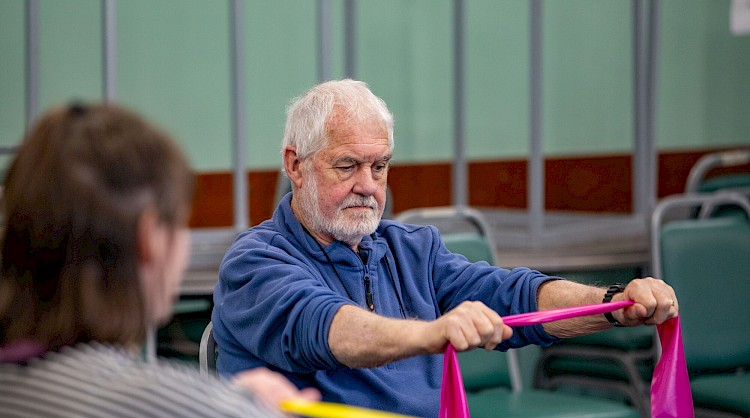
Loneliness is increasingly recognised as an important issue with considerable implications for our individual and collective health, and one that needs to be tackled as a society to improve quality of life for everyone.
Research offers a way to do that; by understanding the causes, experiences and consequences of loneliness and social isolation, as a society we can develop interventions and solutions to boost social connections and reduce loneliness. As a charity, we want to ensure that no one is ever too old to make friends.
We know that people’s experiences are different, but we also know that older people can be particularly vulnerable due to factors such as living alone, being widowed, and having long-term health conditions.
Whatever your experience of loneliness and isolation, by taking part in research, you can help us and our research partners better understand the lives of people aged 75 and older.
Benefits of taking part in research can include:
- Gaining a better understanding of loneliness and social isolation
- Sharing experiences, opinions and advice
- Helping others
- Making a worthwhile contribution to tackling social isolation and loneliness
If you’re an older person (75+) living in the UK with experience of loneliness or social isolation, there are several ways to get involved in research with Re-engage:
- Join our research group – it’s open to older people who attend Re-engage social gatherings or activities, or who speak to one of our call companions.
- Sign up to our research mailing list – you’ll get updates about opportunities to participate in research projects and the activities of the research team.
- Review the list of current and upcoming opportunities and contact the researchers directly, or email research@reengage.org.uk to find out more.
Current and upcoming opportunities
Living with long-term pain can have a significant impact on quality of life, but some older adults cope better than others. This study explores whether attitudes towards ageing, feelings of loneliness, and levels of self-compassion influence wellbeing among older adults living with chronic pain. Findings will help improve understanding of the factors that support or undermine wellbeing in later life and may inform future psychological interventions and clinical support for older adults living with chronic pain.
Participants should be aged 65 or over, living with chronic pain that has lasted for three months or longer, and able to complete a questionnaire in written English. Participation involves reading a participant information sheet, completing a short consent form, and completing a one-off questionnaire that takes approximately 20 to 30 minutes. The questionnaire includes questions about pain, quality of life, attitudes to ageing, loneliness, self-compassion, mood, and basic demographics.
The survey can be completed online, or you can request a paper version to be sent to you in the post with a prepaid return envelope. Participants who consent will be entered into a prize draw to win a £100 Amazon voucher.
Surveys are expected to run until 1 February 2027.
To find out more or to take part, contact Zoë Bird via zoe.bird.2024@live.rhul.ac.uk.
This study explores how people in the UK manage the practical tasks that follow a death, such as registering the death, sorting belongings, and dealing with probate, and whether some groups face greater barriers than others. These processes can often be complicated, lengthy, and isolating especially for bereaved people and those who support them. Working with the National Bereavement Service, the research aims to understand these challenges and develop recommendations to make death administration clearer, fairer, and easier for families and professionals. Findings will be used to improve UK policies and practices, helping reduce complexity and ensuring better support for bereaved people.
Participants will be asked to take part in an online survey (around 20 minutes) and / or an interview (around 60 minutes). Surveys are completed online, and interviews can be online or face-to-face. To take part you must be 16 or over and have completed any form of death administration in the UK within the past three years. Offline options are available if needed. Surveys are expected to run until November 2026, and interviews will take place from early 2027 to June 2027.
To find out more or to take part, please contact Dr. Sophie Atherton via sophie.atherton@manchester.ac.uk.
People are living longer than ever before, so it is important to understand what helps people stay healthy and happy as they age. Wellbeing includes not just physical and mental health, but also a sense of purpose, enjoyment, and positive relationships. A key part of wellbeing in later life is Self-Perception of Ageing (SPA) which refers to how old people feel compared to their actual age. People who feel younger than their actual age often report better health, higher life satisfaction, and even longer lives.
This study will look at how SPA, retirement, and new relationships relate to wellbeing in two groups of older adults: those aged 60–74 and those aged 75 and over. Researchers hope that comparing these groups will help show how experiences and views of ageing can change across later life, and that findings can inform future interventions, public health initiatives and policies that promote healthy ageing and support the wellbeing of older adults.
Participants should be aged at least 60 years old and fluent English speakers living in the UK. You will be asked to complete an anonymous survey that includes questions about how they perceive their own ageing and their attitudes to ageing, their wellbeing, retirement experiences and relationships. The survey can be completed online, or you can request a paper version to be sent to you in the post with a prepaid return envelope.
To find out more or to take part, contact Heather Archer via h.archer.1@research.gla.ac.uk.
A social work PhD student at the University of Bristol is conducting research on friendship, social connection and community spaces, aiming to highlight what is important in older people’s social connections and how we can be supported to make and maintain friendships as we age, reducing loneliness and social isolation.
Laura Bennett is interested in talking to older people (aged 65 and over) about their friendships, including what’s important and what meaningful friendship is, what an ideal network looks like, and attending community spaces or activities to make or meet friends. Taking part would involve an interview lasting 45 minutes to one hour, either in person or over the telephone. Participants will receive a £10 shopping voucher as a thank you for their time.
If you’re interested in taking part or would like to know more, you can contact Laura via l.bennett@bristol.ac.uk or call her on 07930578102.
This study explores how difficult experiences in childhood are linked to depression in later life, and whether feelings of loneliness and how comfortable people feel giving or receiving compassion may help explain this relationship. As well as a better understanding of the factors that contribute to depression in older adults, the project aims to support the development of more effective ways of helping people in later life.
You do not need to have lived experience of trauma, loneliness, compassion or depression to take part. Participants should be UK residents aged 60 or over who can read English to complete a 25-30min online questionnaire about childhood experiences, loneliness, compassion and depression.
You can access and complete the questionnaire online.
To learn more about the study, please email Claudia Rodriguez at s2767170@ed.ac.uk.
Researchers at Royal Holloway are looking for retirees aged 65+ to take part in a study that has the potential to shape future support for retirees in the UK.
Participation involves an interview about your social interactions – you won’t be asked for conversation details, the researchers are interested in how many different people you spoke to, how old they are and so on.
Participants will also be asked to complete a range of tasks such as describing everyday objects and answering questions about movie reviews. Audio recordings of you speaking will be taken during some of these tasks.
Taking part is likely to involve two to two-and-a-half hours of your time, and you can choose a location or visit the university in Egham.
Participants need to be aged 65 and over; have been retired for at least six months, but no younger than 60 at the time of retiring; speak English as their first language and not speak any other languages on a regular basis; have no diagnosis or history of conditions affecting language or memory (for example, dementia or stroke).
If you are interested in taking part, contact Carys Dally for further information at carys.dally.2024@live.rhul.ac.uk or 07918216583.
Researchers at the University of Edinburgh are conducting a study exploring how older adults experience housing transitions, such as downsizing, moving into supported housing, or choosing to remain in their current home despite challenges. The project focuses on how these changes affect wellbeing, independence, and social connections.
They are currently looking to speak with people aged 60 or over living in Edinburgh, East Lothian, Midlothian, or West Lothian who have either:
- moved home within the past three years, or
- considered moving but decided to stay.
Participation involves a one-off interview (by phone, video call, or in person), lasting around 45–90 minutes.
If you are interested or would like more information, please email Stephen Chang, PhD Researcher.
Hearing loss can have far-reaching effects on an individual’s life, including impacts on social and emotional wellbeing, and social participation. ‘Hearing sciences – Scottish section’ is a research group dedicated to advancing knowledge and understanding. and improving the lives of people who experience hearing loss. Whether you consider yourself to have a hearing loss or not we are always looking to invite new participants to our department in Glasgow. If you are interested in taking part or would like more information, please email the team.
LEAP study: LGBTQ+ Inclusive Home Care Provision for Older People is currently looking for interview participants. The aim of this study is to better understand how prepared people working in home care are to support older (aged 60+) LGBTQ+ people in England and Wales. As part of this study, we plan to conduct interviews (in-person or online) with older LGBTQ+ people or their partners / informal carers about their experience receiving home care. We are looking to interview people who identify as LGBTQ+ and are 60+ who have experience of receiving home care in England or Wales (within the last 10 years), and currently live in England or Wales. All interview participants will receive a £20 high street store voucher as thanks for participation. To participate or learn more about the study, please contact Shannon O’Rourke by email: s.orourke-11@kent.ac.uk or by phone: 07907878293.
Taking part in research frequently asked questions (FAQs)
Anyone aged 75 and over can sign up to take part in our loneliness and social isolation research. You can register on behalf of someone else if you have their consent.
We have many different types of projects, from trialling technology aimed at reducing loneliness to in-depth life-experience studies.
Opportunities to take part in loneliness research are varied and can include:
- Reviewing materials and providing feedback;
- Completing a survey;
- Being interviewed over the phone or in person;
- Showing researchers your local neighbourhood;
- Trialling a new piece of technology;
- Taking part in steering groups or focus groups;
- Conducting a video interview.
If there are studies that are relevant to you, the research team will contact you to discuss what is involved. You can ask as many questions as you wish before deciding whether to take part. If you’ve registered your interest and are invited to take part in a study, there is still no obligation to take part.